Why the Rules of Getting Hired Have Changed — and What That Means If You Are Changing Careers

For a long time, the unspoken rule of professional hiring was straightforward. If you wanted a well-paid office-based role, you needed a relevant degree and a career history that moved in a straight line through your chosen sector. Career changers struggled because they had neither of those things in the right combination. That model is changing, and the change is significant enough to matter directly to anyone currently sitting outside the industry they want to move into.
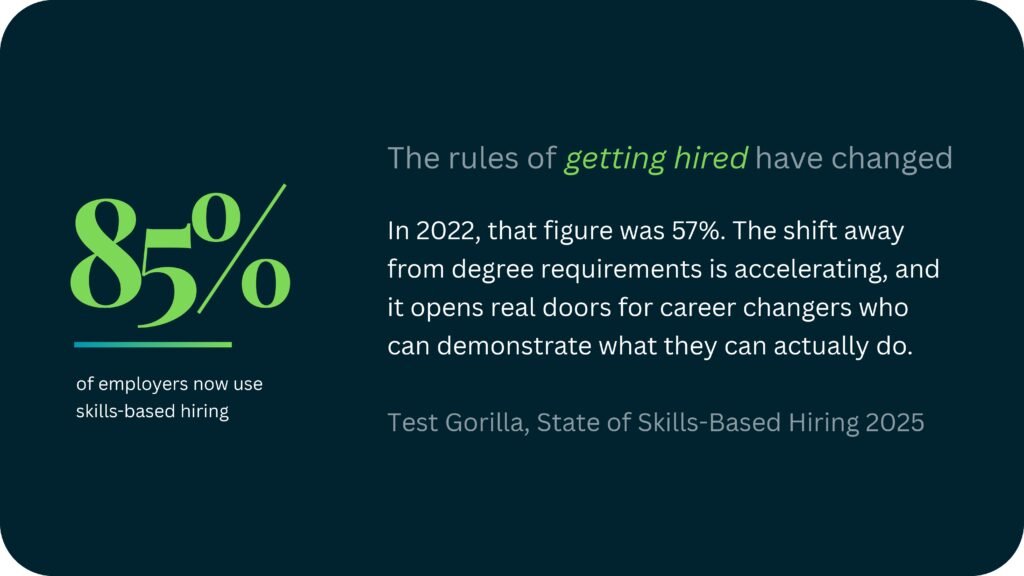
Research from TestGorilla in 2025 found that 85 percent of employers now use skills-based hiring practices, up from 57 percent in 2022. In the same period, the number of job roles eliminating degree requirements has quadrupled. Companies including IBM, Google, and Apple have removed degree requirements from large portions of their job listings — not as a diversity initiative but as a practical response to a talent market where the traditional pipeline is not producing enough of the right people.
What skills-based hiring actually means in practice
Skills-based hiring means that when a company is filling a role, it is evaluating whether a candidate can do the work rather than checking whether they studied the right subject in the right place. In practical terms this shows up as competency-based interview questions, skills assessments, and job descriptions that list capabilities rather than credentials.
For someone changing careers, this matters enormously. The traditional model filtered primarily on career history within a specific sector. A skills-first model evaluates what someone can actually do — which means a professional with ten years of stakeholder management, structured delivery, and process improvement experience can compete directly with someone who spent those same ten years doing similar work with a different title in a different industry.
Key point: Skills-based hiring does not lower the bar. It shifts what the bar is measuring. For career changers with strong, demonstrable experience, that shift opens doors the traditional model kept closed.
What this means for your CV and LinkedIn profile
The shift to skills-based hiring has a direct implication for how your application materials need to be built. A CV that describes what you were responsible for does not answer the question a skills-first hiring manager is asking. They are not looking for a job description. They are looking for evidence that you can produce a specific outcome in their context.

LinkedIn data shows that employers who focus on skills when hiring are 60 percent more likely to make a successful hire than those who rely on credentials alone. That finding cuts both ways. It means the companies you are applying to are increasingly receptive to evidence of capability regardless of where it was developed. It also means the burden is on the candidate to present that evidence clearly.
The gap that still exists
The rise of skills-based hiring does not mean that career transitions have become effortless. A 2025 analysis published by The Interview Guys found that while 85 percent of companies claim to use skills-based hiring, only a small proportion of actual hires are genuinely affected by skills-first evaluation. The gap between stated policy and lived reality means that career changers still need to work harder to make their case legible to a hiring audience.
The practical implication is that a well-positioned application from a career changer can compete directly in a skills-first market. A generic application, where the connection between previous experience and the target role is left for the reader to figure out, will not.
Key point: The market is shifting in a direction that is genuinely favourable for career changers. The practical challenge is making sure your application materials are built to take advantage of that shift.
Ready to make your move into tech?
Book a free consultation call and find out exactly where your background maps onto the tech market right now.